



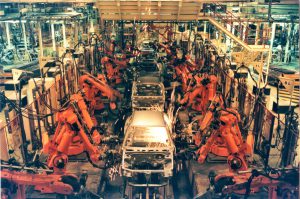
It seems like every day we hear the siren calls of ing end of jobs. A new report out of thePwCsays that 38% of all jobs in America are at risk of being automated. This mostly affects jobs that require little to no education, which could include entire industries, such as truck driving, storage, or food service.
We are told that the trade-off will be “worth it.” Millions of jobs will be destroyed. Uneducated workers, the very ones whose jobs will be eliminated, will face potentially permanent unemployment and the already enormous class divides will worsen. But never fear: productivity and production will increase.
For many people, such reports are alarming or even hard to believe, but for those of us in Appalachia, it is like déjà vu.
Growing up in a small Appalachian town, I was often told that our way of life was “behind the times.” Yet I believe that much like the tortoise, somewhere among all the energy, excitement, and frenzied activity of the city, the people of these woods have quietly taken the lead. The very people portrayed as “slow” have out-paced the hare in the march of history.
If you want to see the future, look to the mountains.
I’m pastor a church in Bluefield, WV, once known as the “Gateway to the Coalfields” or even “Little New York.” A few decades ago, our city was booming. We were mercial and economic hub, an industrial powerhouse. Times were good, but there was one looming problem.
As J.R.R. Tolkien once wrote, “A safe fairyland is untrue in all worlds.” All of our economic activity was tied to one industry, affectionately known as “King Coal.” As early as the 1950s, the writing was on the wall, new machines (such as continuous miners) and increasing globalization were going to deliver a mighty blow. A major percentage of our jobs were at risk of being mechanized or outsourced.
In the 80s, the predictions of economic destruction became reality. Personal e and housing values plummeted. Rates of drug abuse, domestic abuse, and suicides climbed. Schools were crumbling and students were failing. As Ronald Bailey recently explained, “Only 32% of adults are in the civilian labor pared to 63.5% nationally.”
When second and third generation coal miners lost their jobs, they no longer knew who they were. They had always been coal miners, raised by coal miners. Now their very identity was gone.
Our economies began to produce people that had little to no hope and a low view of themselves. Our local governments became dens of self-interest and self-preservation, leading to self-serving and uncharitable policies. It was not a short road from mechanization to poverty, but it was the path of least resistance.
In hisbookDavid and Goliath,Malcolm Gladwell writes that “the act of facing overwhelming odds produces greatness and beauty.” Being an underdog “can change people in ways that we often fail to appreciate: it can open doors and create opportunities and educate and enlighten and make possible what might otherwise have seemed unthinkable.”
This is the story of Appalachia. Many people have been crushed and many families destroyed in the wake of this storm. But among the ashes, a few flowers have begun tobloom.
One of the greatest joys in my life is to witness the “greatness and beauty” now being produced in Appalachia. The path has been long and hard, but that may be the very reason for the sweetness of the victories.
Many of the sources of greatest pain have given us our strength. We clearly recognize that we are not playing on the same economic field as the rest of the country. Yet the loss of some economic incentives has actually freed us to find other incentives. For many people I know, these incentives have e munity, and justice.
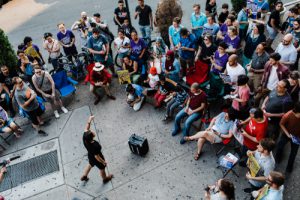
In the best of munity, I see neighbors looking out for neighbors. I see people finding dignity not just in their job but in being a good friend, growing a garden, or making art in their back yard. I see cooperation like I never thought was possible. I see government employees working together across borders of cities, counties, and even states. I see local lawyers offering to volunteer their time to any entrepreneurs with ideas for patents. I see local colleges with a renewed interest in adding value to munities they serve.
I personally host a group of over 100 business owners that mitted to doing business locally because we are all in this together. I challenge them to refuse to buy from someone that does not have a face, or at least one you have never seen. We are shortening supply chains and localizing production. I am seeing businesses promoting other businesses and bartering making eback.
I see many people starting their own businesses. Providing a good service to their neighbors at a reasonable price. Seeing needs in munity and stepping up to offer a solution. Being voices of dignity and pride to our young people.
I see churches serving under resourced schools, offering tutoring, and delivering messages of hope.
I see the economically privileged deciding to stay and invest in munities instead of moving to the beach. I see the ing out of retirement to teach and to “make.” We are munity of makers.
I see trust being regained as we spend time with each other. I see former barriers of class or race disappearing at the very time that much of the country sees the opposite.
I think most of this would have been impossible if not for the path we have walked. Despair seemed inevitable but we never gave up. The path ahead of us is long and it is not going to be easy but silence is not our future and despair is not our end. Hope is rising and hope is not easily extinguished.
Let us return to where we began. America will soon be faced with a similar crash in the job market as what Appalachia has been through. Economists speak of potential “solutions” to the problems that will be created. These include an idea for aUniversal Basic e, known in our area as “the draw,” or even the idea of a “federal job guarantee.”
It seems obvious to me that they are looking to the wrong “experts.” Why would you not turn to the ones who have been through the battle and have field tested strategies and resources? I think it is simply pride.
It is humbling to turn to the shepherd, the one from the backwoods. The one with the thick accent that you have previously mocked. The one you called “slow.” It is hard for the hare to turn to the tortoise. It is hard to believe that the very solutions our country needs are best articulated with a country twang.
It seems impossible that the experts are hillbillies, but Gladwell points out that, “Gifted children and child prodigies seem most likely to emerge in highly supportive family conditions. In contrast, geniuses have a perverse tendency of growing up in more adverse conditions.”
As we look to the future, I challenge you to include us in the conversation. You may just be surprised!
This is an adapted version of an essay originally published on Medium.
Image: PublicDomain








 zpostcode
 Recruit
 weather
 mreligion
 Yellowpages
 sport
sport constellation
 shopping
 name
name game
game directory
 literature
 Word
Word tour
tour furnish
 Lottery
 tftnews
 lyrics
 News
News digital
 car
car dir
dir Edu
Edu Finance


