



For almost a decade, many thoughtful people have agreed that something called “liberalism” is under assault in America without ever concretely explaining what liberalism is. Two weeks ago, John McGinnis brought unusual clarity to the discussion in these pages with a two-sentence summary of liberalism that was comprehensive and specific. Liberalism, he said, “has historically been marked by independent courts, free trade, protection of property rights, and a limited state, even if it incorporates social welfare programs” and could be linked to figures ranging from Margaret Thatcher and Ronald Reagan to Lyndon Johnson and George Bush.
McGinnis is correct about liberalism’s historical features, but it is important to note that it can be divided into two very different approaches for how to achieve them, splitting figures like Reagan and Thatcher on one hand from Johnson and Bush on the other. We might call the two approaches “classical liberalism” and “managerial liberalism.”
Classical liberalism emphasizes representative government bolstered by associations close to the people; free markets with limited but flexible government adjustments; and non-interventionism abroad. Managerial liberalism emphasizes centralized government by large institutions; the use of administrators, judges, and university and philanthropic leaders to devise policies; and foreign wars to protect interests abroad.
These two competing approaches are the main shapers of America’s political development, and the extremes in our politics today come from a particular turn in their competition. Sometime between 1933 and 1969, managerial liberalism supplanted classical liberalism, which had been dominant before. This has given rise to our present discontents, which are not rebellions against liberalism per se but against one failed version of it. Tracing the assumptions and progress of these two versions of liberalism shows the triumphs of America under classical liberalism, and America’s slow decline under the managerial alternative. In drawing this sketch, I hope to suggest how to find our way back.
Classical Liberals vs. Managerial Liberals in Europe, 1690–1787
Like Americans themselves, the options for governing them came from Europe: from two channels of thought about how government and markets should interact. As scholars such as Michael Sonenscher, Istvan Hont, and Gordon Wood have shown, this body of thought emerged during two early-modern historical shifts: the expansion of commerce as religious wars waned and government’s increasing use of money (“capital”) borrowed from private lenders to pay for territorial wars.
The market-based regimes these shifts created were no longer divided vertically into classes. Instead, the fundamental social principle was division of labor—people became defined by the jobs they did, the compensation and prestige they received, and the increasingly specialized goods they bought. Rising numbers of people in these countries were well-off and self-confident enough to demand relative equality under the law and some form of elected government. Between about 1750 and 1790, the two forms of liberalism began offering answers to the question of how this governing should be done.
The first was classical liberalism, and its preeminent theorists were British: David Hume and Adam Smith. Hume and Smith, writing from a country with growing middle-class wealth and a powerful parliament, believed market society should guide government through representative assemblies, and these assemblies’ overall goal should be trade not war. Hume and Smith saw exceptions to this; Smith supported tariffs, notably, when national security was involved. But Smith was also one of the earliest and most ardent to warn against British imperialism’s costs—and one of Hume’s essays he was most invested in was his jeremiad against public debt, which funded this empire in the first place.
The second school was managerial liberalism, and its preeminent proponents were French: Jacques Necker and Emmanuel Sieyes. Necker and Sieyes, writing from a country with no representative government and a vocal but minuscule middle class, believed a robust state shaping society was the only way to achieve broad-based wealth. Necker emphasized heavy government investment in the economy using public debt to improve Frances standing, and other administrators favored wars for empire. Sieyes, a leader of the first revolutionary government, constructed a constitutional system meant to empower an activist government. He aimed to create a new governing class by merging national elections with promotions for elected officials based on seniority: a nightmare synthesis (at least for conservatives) of democracy and bureaucracy.
After Americans split from Britain and had to decide how to govern their new country, these two forms of thought came first into convergence and then into conflict. James Madison took up the cause of classical liberalism, while Alexander Hamilton adopted managerial liberalism. The two had famously collaborated to sell the Constitution to Americans in The Federalist, but split abruptly four years later over their clashing political-economic visions of what the Constitution should mean.
Classical Liberalism’s Triumph in America, 1787–1933
Their split is not surprising considering their lifelong beliefs. As his notes for the Constitutional Convention make clear, Madison’s innovation was to apply the economic principle of divided labor to politics to maintain the political primacy of America’s state legislatures by, paradoxically, limiting them of specific powers and reposing those powers in the national Congress. Here Madison was echoing Smith, who before the Revolution had proposed keeping Americans part of Britain by allowing them representation in Parliament: giving them a say in taxation rates and rescuing their leaders from the “rancorous and violent factions” of “small democracies,” e.g. colonial legislatures. Like Smith, Madison advocated reducing the power of factions in states by giving more powers to a distant legislature, this time in Washington. But, for Madison, this reduction functioned as the means for national statesmen with broader visions to check states extremes; it was not meant to create a vigorous national government. In a market society of divided labor, Madison reasoned, political interests would be divided as well, so long as the sphere of politics was broadened to prevent one type of interest from dominating any one place.
Hamilton held no such confidence in markets. Echoing eighteenth-century Christian thinkers, Hamilton believed that a market society corrupted most of its people with consumption and luxury. The only solution to governing it was to insulate authority with a virtuous elite. This elite would work through a national executive, aided by a compliant national legislature, to aggressively set the terms for the country. For Hamilton, who cited French economists like Necker, this meant supporting public debt and a national bank connected to the government; and favoring certain industries that would contribute to economic growth. His goal was to stretch representative government as far as it would go to empower administrators. As Treasury Secretary in the 1790s, he actively worked to centralize power away from the states and Congress.
Hamilton had a narrow set of powerful allies among Northeastern academics and financiers. But their view was a distinct minority, and so after the election of 1800, the classical liberal vision of Madison and his ally Thomas Jefferson dominated American politics.
In power, the Madisonians were not dogmatic. For example, they maintained free trade principles, but as a practical matter they supported tariffs, and even an embargo against Britain, for national security reasons. Madison, an opponent of Hamilton’s National Bank, created a second one in 1816 to encourage investment from abroad after a defensive war with Britain depleted America’s economy. Nonetheless, the bulk of their policies decentralized power and secured free trade. In the process, they determined that America’s development would come primarily at the hands of state legislatures which regulated health and morals, with the support of the voluntary associations Alexis de Tocqueville made famous—trade unions, city parties, business and moral associations, and churches.
This meant that some of Hamilton’s and his allies’ ideas went into effect—but within a classical liberal structure. Abraham Lincoln, for example, embraced Jeffersonian themes to win the presidency but also introduced a banking system and a university system. All the same, he centered these Hamiltonian policies on localities and the states, making them more acceptable to believers in decentralized government. Lincoln also instituted high tariffs, but when successor Republicans raised tariffs too high they suffered electoral blowback in the 1890s. In the 1910s, in another push that expanded central power, Louis Brandeis advocated for antitrust policy to break up large corporations—but, as the legal scholar Jeffrey Rosen has recently teased out, he put this policy squarely in the classical liberal tradition of using the national government to oppose bigness while leaving most political prerogatives to states, which he called “laboratories of democracy.” His antitrust proposal, as Carl T. Bogus points out, was also the least centralizing anti-monopoly option on offer.
The Rise, Triumph, and Tragedy of Managerial Liberalism, 1933–1981
The 30-year period from the onset of the Great Depression to the start of the Kennedy presidency was a transitionary time. The Democratic Party, which navigated the Depression, World War II, and the early Cold War, made controversial policy decisions. But, as scholars like Wendy L. Wall have contended, all of them could be described as pragmatic efforts to preserve a free market republic from domestic unrest or foreign aggression.
“The New Deal,” for example, created welfare programs to ease popular discontent and dissaude Americans from embracing fascism or communism. Along the same lines, the mobilization of military, economic, and academic might in World War II and the Cold War protected Americans by stopping Right and Left extremes from capturing Europe and becoming unstoppable global forces. These mobilizations were also achieved with buy-in from on-the-ground associations and state legislatures. But, in the process of making these adjustments, institutions that had been set up by the descendants of Hamilton’s allies in Boston and New York after 1860 gained enormous power. This shift allowed managerial liberalism to quietly supplant the classical liberal order.
Hopefully, intellectual dissidents can make common cause with disaffected Americans to revive our classical liberal republic.
These Ivy league universities, corporate consultancies, and philanthropies did and do provide invaluable research, data-gathering, and charitable capacities to America. But they were set up by people who embodied Hamilton’s managerial ideology to their fingertips, and who in the 1950s moved laterally to staff the new government agencies. Standardization in the name of “progress” and security was their aim; theories and metrics were their methods; the authority of experts was their faith. When representative government stood in the way, it was made to give way.
From intervening abroad based on “domino theory” to managing the “de-socialism” of American Indians by draining Indian reservations of their resources, these managers advanced theoretical agendas with incredible on-the-ground costs. Increasingly, as self-critical liberal scholars like Jeffrey Toobin have realized, they also began to use legal challenges to shift American life in sweeping ways at the national level on issues ranging from environmental protection to women’s rights—resulting in the proliferation of agencies and regulations.
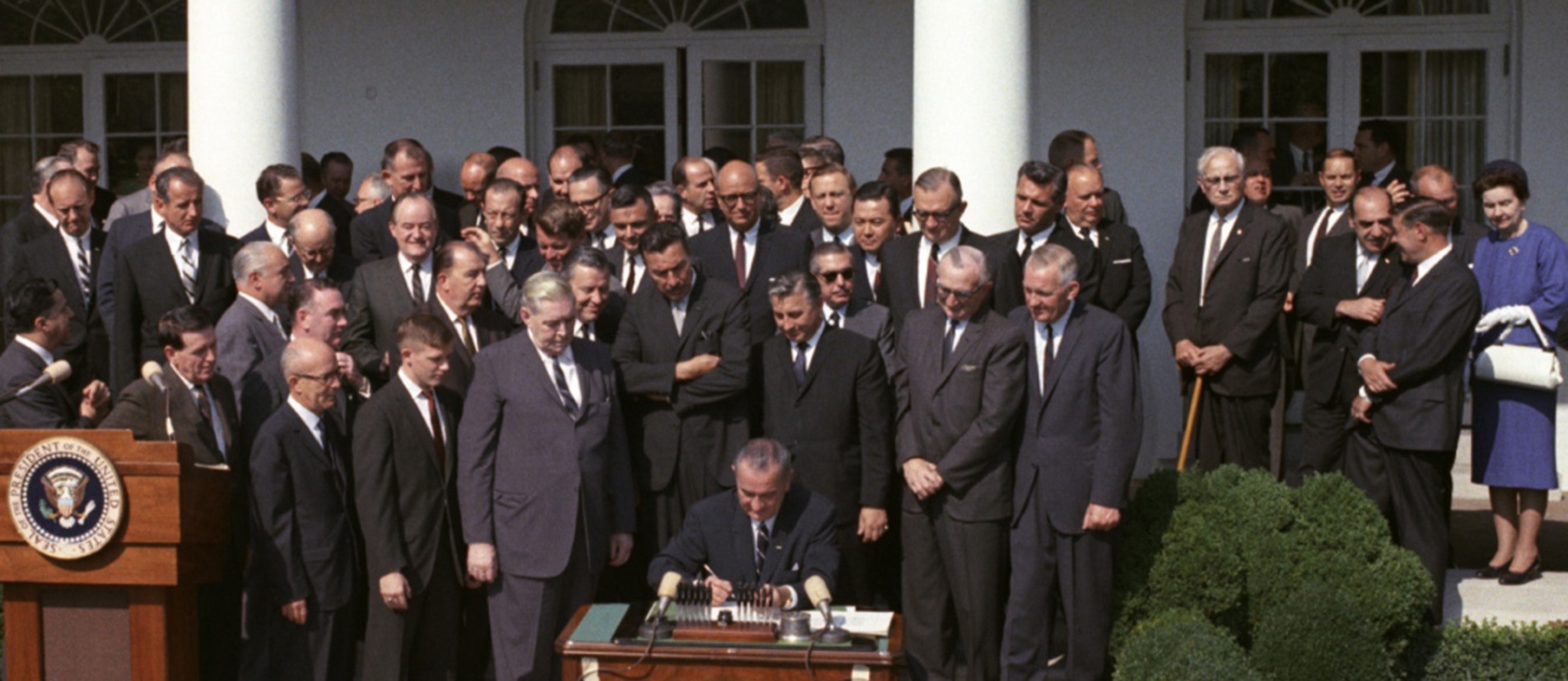
The Kennedy, Johnson, and Nixon administrations turbocharged earlier interventions with what they called domestic “wars” on concepts such as “poverty,” “drugs,” and “racial injustice.” Each of these, managerial liberals claimed, justified mobilizing the national government, even if the issues didn’t rise to the level of an urgent, sweeping crisis. Supporters may have called these policies quests for equality or individuality, but in reality they were a power grab from Washington the likes of which had never been seen.
The Recovery and Crisis of Managerial Liberalism, 1981–2015
Scholarship over the past twenty-five years has emphasized the impacts of this “Leviathan” government in the 1950s, 1960s, and 1970s—and the judgments have not vindicated managerial liberalism. Many of these policies empowered central planners at the expense of more local Tocquevillian voluntary associations. Even attempts to “reform” governing institutions led to a stronger bureaucracy and more government spending.
In this context, these series of willed errors by managerial liberals, Ronald Reagan’s achievement in the 1980s was an extraordinary one. Elected by a populist, states-based movement like the ones of America’s classical liberal heyday, he rescued the managerial system using classical means, and for classical ends.
He trimmed managerial liberalism’s worst excesses since the 1960s by curbing domestic welfare, taxes that funded it, business regulations, and public sector unions—even as he pragmatically used certain tariffs to protect American workers whose standard of life was being threatened by inflation. Through his Supreme Court picks, he made states important legal players in the constitutional system for the first time since the 1930s, restoring at least a minimum of balance with Washington. He also poured short-term resources into a worldwide campaign to “roll back” Soviet expansion, which, according to historians taking both the American and Soviet perspectives, ended up forcing Soviet reform. This meant that by 1993 the fiscal and military burden of the Cold War was lifted from Americans.
Reagan achieved these successes in no small part thanks to bands of dissident intellectuals, among them economists like Edmund Phelps and legal scholars like Robert Bork, who pushed against managerial doctrines of government spending to create full employment and liberal constitutional interpretation untethered from the Constitution’s text. But in the years after Reagan’s triumphs, managerial liberals, mostly Democrats but some neoconservative Republicans, captured the economists’ side of the creative dissent and turned it into dogma. “Republicans know business, but the Democrats know the new management theories,” a connected Democrat told The New Republic in the early 1990s, summing up the shift.
In the 1990s, managerial liberals linked to elite universities struck back by codifying free markets into an “anything goes” deregulatory boondoggle which ended up making a handful of corporations “too big to fail.” Outsourcing also became standard Washington practice. Free movement of peoples turned into a liberal shibboleth, ignoring real concerns about security and societal change brought by immigration. Managerial liberals also advocated aggressive interventions abroad to preserve American empire—from Bosnia to Kosovo, Iraq to Afghanistan—which often amounted to bureaucratic boondoggles at the cost of trillions of dollars in deficit spending and frayed relations with much of the rest of the world.
Domestically, to generate political enthusiasm in a country where voluntary associations were increasingly attenuated, both Democrats and Republicans relied on moral appeals. Neoconservatives, operating from think tanks and corporations, rallied behind Washington-based “compassionate conservatism.” Progressives, whose power base was universities and nonprofits, adapted a vision of “diversity-through-equity,” also led by Washington.
Meantime, among communities left behind by corporate concentration and “free trade,” backlash grew. This was not because free markets were inherently faulty. It was because their application at the hands of managerial liberals was, characteristically, sweeping, dogmatic, and not attuned to on-the-ground fallout and dissent. What this application lacked was a feedback mechanism, beyond samplings of essentially self-selected citizens polled by the new political strategy firms in Washington, of how policy was affecting people on the ground. The old circle between government and society, politics and the market, stability and change, which had been ensured by associations and state legislatures had been broken by centralization. Now the national government and its outgrowths were firmly in control.
The Road Ahead for Classical Liberals, 2015-present
Since Donald Trump and Bernie Sanders mounted their presidential primary campaigns in 2015, liberalism has been seen to be in crisis from the Right and the Left. But it would be more accurate to say that managerial liberalism is in crisis and classical liberalism is eclipsed. The idea of national government pursuing a non-interventionist foreign policy and a flexibly free market agenda while leaving society to look after itself via the states is rhetorically nonexistent. It is obscured by widespread progressive-Left rebellions against free speech and property; narrow “postliberal” plans for Christianizing Washington; and management liberal responses which expand government in the name of “the people.” Finally, popular Republican references to nationalism and autarky make classical liberals wonder if they have lost their party.
But on the level of specifics not rhetoric, the classical liberal picture is brighter than it might seem among Republicans from a wide spectrum of allegiances and beliefs. Their views suggest that a commitment to representative government and free markets can adjust to present circumstances without losing sight of overarching principles. Realists are advocating a new foreign policy restraint, for example, and certain state governors are reasserting their authorities under our classical liberal Constitution. Meanwhile, and especially since the coronavirus pandemic, voluntary associations are shaping on-the-ground politics at levels unseen since the Reagan Era in opposition to expansive national mandates.
Perhaps most importantly, originalist judges, supported by almost all Republicans outside of a narrow set of academic critics, have liberated markets from managerial liberal regulations in Washington, DC. And yet, in some notable recent instances, some originalists have been decisive votes allowing states to regulate markets. This, in turn, preserves the balance between free markets and state-based representative government which was fundamental to classical liberals from the beginning.
What all of these approaches share is that they’re principled but flexible, committed to ideals but close to the ground—which is exactly what classical liberalism has always been, in contrast to the managerial alternative. Eventually, hopefully, intellectual dissidents can make common cause with disaffected Americans to revive—via associations, states, and Washington reformers—our classical liberal republic.
Right now, classical liberals are caught between Left and Right reactions and the managerial liberal status quo which caused them. Our responsibility is to carve out, clearly but with nuance, a fourth way. As McGinnis rightly points out, promoting individuality and peace in an age of extremes means fighting the extremes. But that, in turn, means creating a distinct and responsive alternative politics which answers people’s major questions—what has gone wrong; how to fix it—and presenting it to the public.





 zpostcode
 Recruit
 weather
 mreligion
 Yellowpages
 sport
sport constellation
 shopping
 name
name game
game directory
 literature
 Word
Word tour
tour furnish
 Lottery
 tftnews
 lyrics
 News
News digital
 car
car dir
dir Edu
Edu Finance


