



When writing about the deep divisions that beset America today, it is imperative to put things in context first. As hard as it may be to believe at times, we have been more divided at other times in our history. Think of the Civil War and the years leading up to it, filled with promises” that only created aggravation. Or consider Shays’ Rebellion, a Western Massachusetts insurrection that had national implications. There were many other times when we have stopped short of resorting to arms but were still, metaphorically, at each other’s throats.
That is not to suggest that we’re not divided today. In fact, our divisions are so profound that dark voices suggest we are on the verge of a new civil war. Portland, Seattle, Kenosha, Chicago, etc., have reminded us all summer long that we are on the edge. And the violence that broke out in Louisville on September 23 following the verdict of the Breonna Taylor case demonstrates that it’s not over yet. When one sees hard-Left rioters in the streets shooting two police officers, attacking restaurants and stores, and in turn attracting the attention of armed right-wing militants, one shudders.
The question is, “What do we do?” Before getting to policy solutions, it is important to recognize how we got here in the first place.
Cancel culture, the division of the country into categories of oppressors and the oppressed, struggle sessions held at work places, the New York Times’ 1619 Project, victimhood culture – none of these things materialized out of thin air. They mon roots. Their consequences are the riots and disturbances of 2020.
To understand this, we must go back 100 years to Antonio Gramsci, the founder of the Italian Communist Party. To be sure, we could go earlier, to Nietzsche, Marx and Engels, Hegel, and Kant. But we don’t need to.
Gramsci was sent to prison in the late 1920s in order to, as the prosecutor put it, “stop his brain from working.” We know from the example of St. Paul and others that this is counterproductive. In prison, Gramsci had time to think and write.
He realized that, though Marx and Engels had promised the workers would revolt and overthrow the capitalist class, that had only happened in one place during his lifetime: a European backwater called Russia. Everywhere else, including his own country and Germany, revolutions in Western Europe in 1919 had failed to produce soviets.
The reason, he wrote, was that the worker had accepted and internalized all the cultural concepts of the oppressor class: religion, the economic system, the family unit, the nation-state, etc. The capitalist bourgeoisie no longer needed to use the threat of force to get the worker to accept his fate. The worker did it on his own, because he had acquired “false consciousness.”
In order to rid the worker of this false consciousness, a well-trained revolutionary vanguard needed to put him or her through “consciousness-raising” sessions to understand how he was suffering. A revolutionary consciousness would not be formed “under the brutal goad of physiological necessity, but as a result of intelligent reflection, at first by just a few people and later by a whole class, on why certain conditions exist and how best to convert the facts of vassalage into triggers of rebellion and social reconstruction.”
That was Gramsci’s theory of cultural hegemony. The main tool used to put it in practice was critical theory.
Many have now heard of “critical race theory,” because President Donald Trump launched an attack against it on two related fronts: His Constitution Day announcement of a 1776 Commission to counter the leftist indoctrination of schoolchildren and his instruction to the Office of Management and Budget to ban so-called “anti-racism trainings” from the federal workforce. On September 22, Trump extended the ban to contractors doing business with the federal government.
Critical race theory is an offshoot of critical theory, as is its law school branch, critical legal theory. Other spinoffs are all types of ethnic and gender studies. Put together, they amount to what I and many others call the “grievance industry.” Anyone taking classes at a university, or with sons or daughters there, should understand that they are studying some form of this theory. In fact, starting next year the California state university system will require that anyone wishing to get a B.A. or B.S. take a class on ethnic studies. Children in K-12 schools will be subjected to something similar.
Critical theory, the main philosophical school of identity politics, is nothing less than an unremitting attack on all of America’s norms and traditions. Its goal is to replace them with a “counter-narrative” to introduce such ideas as central planning.
The concept dates back to 1937 when Max Horkheimer, the director of a school of thought known as the Frankfurt School, published its manifesto, Traditional and Critical Theory. When the essay came out, these Marxist academics had already fled the German city of that name to escape the Nazis and found a new home at Columbia University in New York.
Horkheimer claimed that traditional theory fetishized objectivity. Critical theory, on the other hand, replaced universal truths peting narratives. The Left’s job was to destroy the “hegemonic narrative” that Gramsci had described and impose its own, and its tool would be critical theory. This nihilistic view dated to Nietzsche and was in itself nothing less than an assault on Christian values and all of Western civilization.
Herbert Marcuse, another Frankfurt school academic who settled in America, added a new wrinkle. During the riots in the 1960s, he realized that the new revolutionary base is not the worker but the “exploited and persecuted of other races and other colors.” The locus of revolution shifted from the worker to identity groups with a claim on victimhood. Very simply, the worker could change his economic status (and, indeed, under capitalism, he could do so easily) while race, national origin, and sex are immutable traits.
Marcuse also wrote that there will need to be “repressive tolerance,” explaining that conservatives’ views will need to be repressed. Cancel culture was born.
Lastly, one of Marcuse’s disciples, Rudi Dutschke, came up with the idea of a “long march through the institutions,” a clear reference to the Chinese Communist Party’s Long March in China in the 1930s. Marcuse blessed the approach, calling it the only one that will work.
Over the past 100 years, Marxism’s message evolved from an emphasis on economics to an emphasis on culture; the locus of revolution shifted from the worker to the identity group; and armed struggle was replaced by the peaceful takeover of all culture-making institutions like the media, the academy, and Hollywood.
This has given us a nation divided into categories based on the immutable characteristics of race, national origin, sex, even disability status. These traits are said to confer a victimhood status that can then be used to demand not only attention and respect, but such tangible benefits pensatory justice. The grievances that are nourished would then be catalysts for seeking pletely transform society, from top to bottom. As result, we have the riots of 2020.
So the question, again, is, “What to do?” Though much of these divisions are taught in universities, the policies on which they are based emanate from the federal government. That is why activists and ideologues spend so much time working the federal bureaucracy. It is there that we need to look first.
The president’s all-out attack on what he calls critical race theory (but is really just critical theory) and his banning of “diversity training” from the federal workforce and federal contractors is obviously a good start. es late in his term, which could be his only one. But at least he has put these issues in the national spotlight.
“Anti-racism” or “diversity” trainings are indeed racist in the extreme, as they posit that traits inhere in race and ethnicity, and that such attributes as punctuality, the use of reason, and love of the written word belong to something called “whiteism.” Noting more toxic could be said to a child, and the president was on target when he called it a form of child abuse.
If Trump wins re-election, conservatives have to keep his feet to the fire on this issue and make sure that he stamps out the struggle sessions that go under the misleading name of “anti-racism training.” If the president loses, this will be a good cause around which the different factions of the conservative movement can rally. Either way, understanding the origin of the identity politics problem will help us with policy remedies.
In my July 2020 book, The Plot to Change America: How Identity Politics is Dividing the Land of the Free, I call for an era of Civil Rights 2.0, which returns to the colorblind promise of the original civil rights movement. It starts with the old Watergate adage, “Follow the money.” As I write in my book, “To start dismantling identity politics, then, and begin the civil rights movement 2.0, we need to stop the government from handing out benefits to those with a claim of victimhood simply because of membership in a protected group.”
Suborning Americans to adhere to identity categories takes many forms. One clear example is preferential contracting programs that reward businesses certified as “disadvantaged business enterprises,” or DBEs. The owner of a business obtains certification as a DBE by being a member of a victim group and swearing in an affidavit that he or she has been “subjected to ethnic prejudice or cultural bias.” Having succeeded in life by ing this obstacle does not prevent certification. University of Maryland Professor George La Noue draws the only possible conclusion: “Thus, social disadvantage is, as a practical matter, established at birth, and cannot be challenged by evidence of a successful life.” DBEs, obviously, need to be discontinued.
Indeed, the federal government should conduct an inventory to find out how many federal statutes make petitive awards based on race. The last time the Congressional Research Service (CRS) did this, in 2011, it found that there were nearly 300 federal statutes that “specifically refer to race, gender, or ethnicity as factors to be considered in the administration of federal programs.” The report added that, though its authors had been prehensive as possible,” their findings were “by no means exhaustive.” The next obvious step is to declare that these statutes contravene the Constitution and the Civil Rights Act of 1964.
One of the most visible set-aside programs is affirmative action in university admissions. Vulnerable high school seniors worried about getting into a good college are being encouraged not just to tick any of the identity boxes, but also to produce victimhood narratives that will get them into the college of their choice. This will take the courts, in the end, to resolve, though the Trump Justice Department took an important step in informing Yale this summer that its admissions program violated Title VI of the Civil Rights Act in discriminating against white and Asian-American applicants.
Lastly, the least recognized form of racial discrimination is one of the most important: the doctrine of disparate impact. This allows discrimination to be found in a policy’s e, not its intent. This is a civil rights lawyer’s dream and leads to arbitrary legal action, since all policies have a “disparate effect” on people, especially when the categories are artificial.
Gail Heriot of the U.S. Commission on Civil Rights has a handy solution I have always supported: having the president inventory the instances in which the federal government uses disparate impact, and then asking the heads of agencies:
1. Do you consider your statute, regulation or policy to impose liability for disparate impact?
2. If so, what is the legal basis for that view?
3. How does disparate impact liability work under that statute, regulation or policy … and what is the agency’s legal basis for thinking so?
4. Finally, why does the agency believe disparate impact liability will survive strict scrutiny?
My own favorite solution has always been getting the government out of the business of category creation. The Office of Management and Budget, for example, created the Hispanic and Asian categories out of thin air in 1977. They made it into the census for the first time in 1980. The different groups jammed into these categories have very little mon except the assumption that they belong to the “victims” group. Thus, they are corrosive to the ethos of e pluribus unum.
The American ideal may not have always been achieved, but we should continue to try rather than give up on it. Only when we aspire to live according to these lights can we avoid the mayhem we are currently witnessing in our streets.
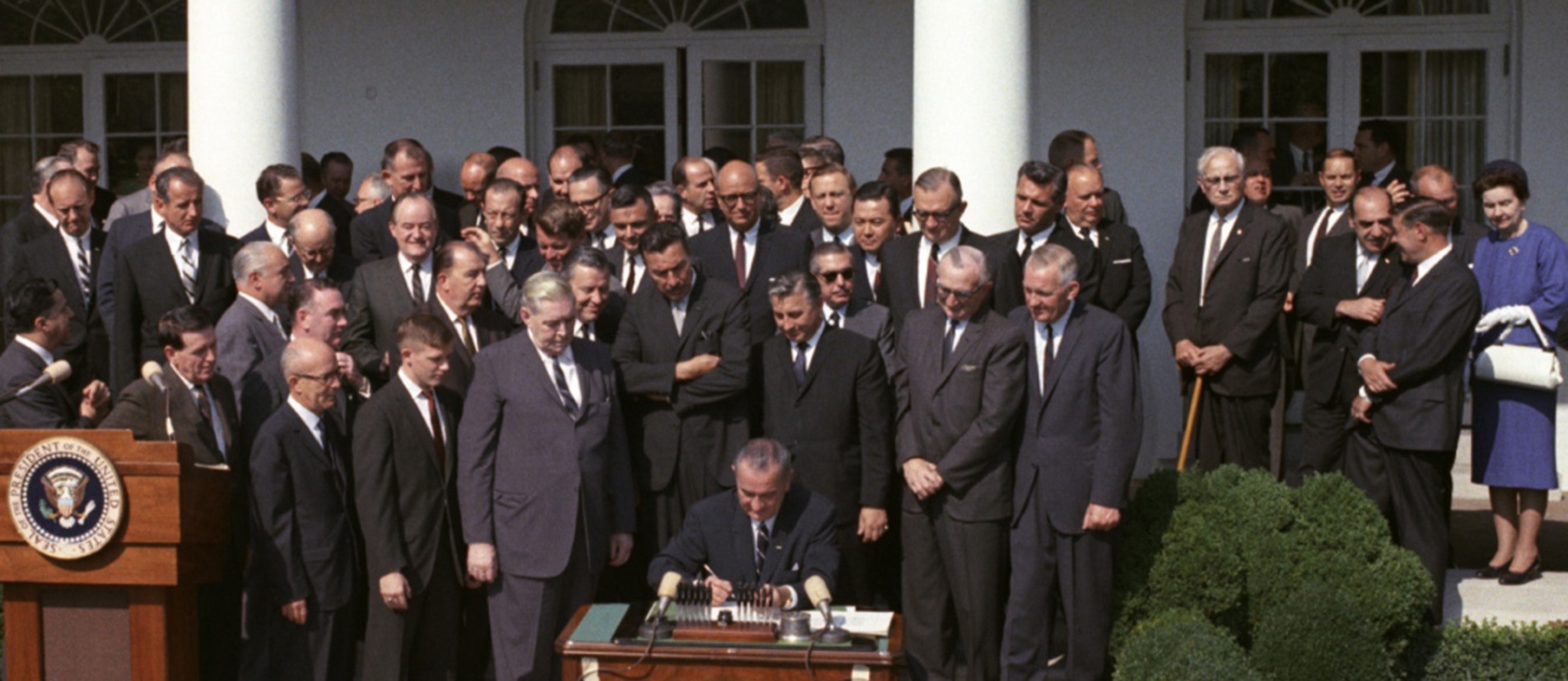
Hickson. This photo has been cropped.CC BY-SA 2.0.)





 zpostcode
 Recruit
 weather
 mreligion
 Yellowpages
 sport
sport constellation
 shopping
 name
name game
game directory
 literature
 Word
Word tour
tour furnish
 Lottery
 tftnews
 lyrics
 News
News digital
 car
car dir
dir Edu
Edu Finance


