



The runaway entitlements of today’s transfer state reflect some of the inherent flaws in democracy. Liberal democracy has succeeded in protecting minorities by constitutionalizing rights. But it is much harder to prevent current majorities from harming future ones, endangering the liberty and security of all.
Democracy’s critics have always worried that the numerous poor would take from the rich, impoverishing all and leading to social conflict and tyranny. But advanced democracies do their transfers differently from ancient ones. The power of the middle class in modern democracy tends to direct the lion’s share of entitlement spending to members of the middle class with little if any means testing. Consistent with the public choice view that democratic legislatures favor concentrated groups over more diffuse ones, transfer spending is then directed to groups that are defined by some fixed characteristic, like age, occupation, home ownership, or level of higher education.
It is an indictment of democracy that neither of America’s political parties seems capable of addressing the fiscal crisis caused by the transfer state. Republicans once had proposals, but the party has undergone a populist revolution and now pledges to do nothing about entitlements. And Democrats, if anything, are only committed to increasing entitlements. Both parties seem to have concluded that the transfer state is a current electoral winner, whatever its future costs.
This aggrandizement of state responsibilities discourages even fully capable citizens from managing their own affairs, leading to a decrease in the liberty and sense of duty at the heart of human flourishing. It is an example of the ways Alexis de Tocqueville prophesied that democracy would put equality before all other principles and turn the state into a kind of replacement for parents. Conservatives can embrace Samuel Johnson’s claim that a decent provision for the poor is the true test of civilization without supporting a welfare state that sweeps almost all within it.
Over the last ninety years, the most striking fact about the federal budget has been its continuing shift from providing public goods to distributing transfers. Public goods are those goods from which the public cannot be excluded and which by their nature everyone enjoys, such as national defense, law enforcement, and clean air. The market and the family cannot provide them, and as a result, they are the prime responsibility of the state.
The New Deal’s introduction of Social Security marked the beginning of this fiscal transformation. The provision of benefits without means-testing gained support from the traditional respect for the old, even as it eroded traditional virtues such as frugality and personal responsibility. It should not be surprising that the largest transfers in American democracy still go to a group defined by their age. The elderly vote more than any other group: in 2020, 71 percent of voters over 75 participated against slightly more than half of the youngest voters. Moreover, since most elderly voters are not employed, they do not pay state or federal income taxes on labor or payroll taxes that fund these programs.
Farm subsidies also became a staple of the federal budget during the New Deal. Roosevelt and his supporters primarily sold these programs to the American people on the specious claim that they were needed to stabilize farm prices, but they also gained support from the traditional respect for those who worked on the land. These programs also are generally not means tested. Members of Congress from farming districts have then historically supported food stamp programs that appeal to many urban representatives in return for retaining these subsidies. Transfers can gain permanence through this kind of logrolling.
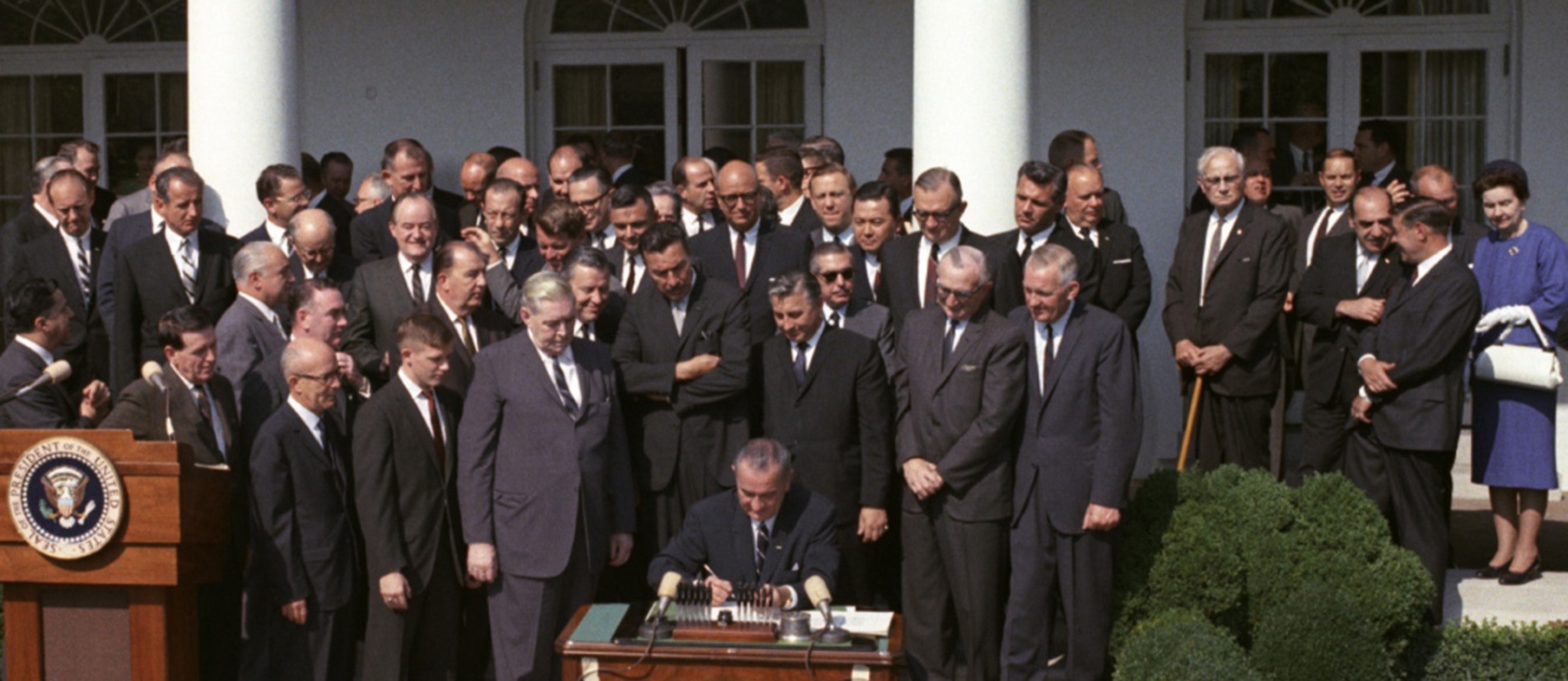
Lyndon Johnson’s war on poverty expanded the transfer state’s scope even further. Many programs for the poor were increased, but at the same time, the Great Society also expanded middle-class entitlements, most notably in the 1965 Medicare Act which provided non-means-tested medical care for those over 65. Nor were government subsidies limited to programs that spent money outright. The federal government also guaranteed home loans so people could more easily purchase homes. These guarantees were worth hundreds of billions of dollars.
President Biden’s student loan cancellation has opened a new front of transfers. His first effort, which was struck down by the Supreme Court, would have provided everyone making under $125,000 with $20,000 in student debt relief. His second plan is more complicated but still would provide loan forgiveness to many in the middle class.
A culture of transfer is a zero-sum game. What is transferred to another person is not transferred to you, as the young are starting to recognize.
Student loan relief with such limited means testing marks the inversion of any view that redistribution focuses on the truly needy. Few of the extremely poor attend college and take out student loans. Moreover, higher education improves the income potential of graduates, making them better off in the future than most of the population.
The student loan program also illustrates how transfers beget more transfers, as groups that are not getting money demand their share. Currently, the costs of Social Security and Medicare (by far the most expensive transfers) are borne diffusely by all workers, including those just starting out from school. While Social Security may create the illusion that people are just recouping what they paid in, most people receiving payments today are gaining far more than they provided in taxes designated for the programs. Because Social Security is a pay-as-you-go program, many young people fear that the program will not be as generous when they reach retirement. So why not demand some government money for themselves while it is still available?
The young have reason to be concerned about whether Social Security will be worth their contributions given the general growth of transfers. They have expanded tremendously, both as a percentage of the federal budget and GDP. Before Social Security, the percentage of the federal budget devoted to transfers was negligible. By the 1970s it had grown to 35 percent, by the turn of the millennium to 55 percent, and by 2020 to 60 percent. Similarly, transfers are increasing sharply as a percentage of GDP. From almost nothing in the 1930s, they are now close to twenty percent of the GDP. The Congressional Budget Office and others project that based on current law even without new entitlements, transfers could approximate 75 percent of the federal budget and 30 percent of GDP. Another way of understanding the tsunami of entitlements is to consider their amount of unfunded liabilities. The Penn Wharton Budget Analysis put these liabilities at $244 trillion dollars under current law.
The costs of this transfer state to our liberty are large. First, the tax burden required to fund these transfers discourages growth and innovation. Europe demonstrates the danger. Most EU countries currently have a more generous transfer state and a higher tax rate than the United States—but also much lower growth and innovation as a result. A metastasizing transfer state also harms democracy because greater prosperity helps democracy endure by giving citizens hope for a continuously better future.
The transfer state also makes it harder to spend on genuine public goods, because citizens understandably balk at paying higher taxes when the taxes and debt (which represents future taxes) required to fund transfers are already high. The threats from China and Russia provide the most obvious example. More generally, our liberty rests on the state’s ability to respond to crises that may require ramping up spending on public goods that the market and family cannot provide.
As Rachel Lu notes, the costs of the transfer state are spiritual as well as material. Responsibility for educating one’s children and taking care of one’s parents is part of what creates family bonds. But as the state has taken over more of the responsibilities, social connections have withered. Loneliness and despair are side effects of a state that takes over the functions that were provided more personally and less bureaucratically by the family, charity, or business.
The transfer state inverts John F. Kennedy’s famous phrase: “Ask not what you can do for your country but what your country can do for you.” A culture of transfer is a zero-sum game. What is transferred to another person is not transferred to you, as the young are starting to recognize.
Thus, the growth of the transfer state puts our liberty at risk in many ways. It weakens state capacity to produce public goods to defend our liberty. It assures hikes in future taxes taking away resources with which we exercise our liberty. It undermines the habits of self-reliance and connection with others that generate a civil society friendly to liberty.
If Thomas Hobbes is to be believed, the modern state was created precisely to prevent a war of all against all. As factions jockey for a greater share of resources, however, the transfer state encourages just such a conflict from the inside. Our old national motto was “Out of Many, One,” but to fit the modern transfer state, perhaps it should be rewritten as “Out of One Comes Many.” A democracy focused on public goods unites citizens, but a state focused on transfers can only divide them.



 zpostcode
 Recruit
 weather
 mreligion
 Yellowpages
 sport
sport constellation
 shopping
 name
name game
game directory
 literature
 Word
Word tour
tour furnish
 Lottery
 tftnews
 lyrics
 News
News digital
 car
car dir
dir Edu
Edu Finance


