

Home
/
RELIGION & LIBERTY ONLINE
/
Robots will continue to ‘take jobs,’ and humans will continue to create more
Mar 11, 2026 10:05 AM

Given the breakneck pace of improvements in automation and artificial intelligence, fears about job loss and human obsolescence continue to consume the cultural imagination. The question looms: What is the future of human work in a technological age?

Innovators such as Elon Musk and Bill Gates have done their share to affirm the predominant pessimism, painting a grim picture of a future defined by robot overlords and diminishing human contributions. “At least when there’s an evil dictator, that human is going to die,” Musk recently observed. “But for an AI, there will be no death — it would live forever.”

The most recent strides and achievements in artificial intelligence are certainly unique in the scope of human history. But as it relates to their impact on the future of human work, the questions have less to do with robotic genius than they do with our faith in human creativity.

In a short film from Freethink, we get a helpful reminder of the historical record. Despite the immediate pain and suffering caused by the various waves of automation and creative destruction, we have yet to see an overall reduction in our opportunities for work and creative service.

“If you think about it,” the narrator explains, “most of the great inventions of the past 200 years have been designed, explicitly, to take our jobs, and yet the fraction of people in the workforce is near an all-time high.”

As for whether this time is markedly different from the rest, once again, the question has to do with whether the depths of human creativity have markedly shallowed. If we only imagine the ongoing developments in robotics, humans will surely e the victim. But as those innovations unfold, we should be careful that we don’t dismiss or disregard the creative developments we’re bound to see from human minds and human hands.

“Whenever a new technology arrives, we can easily see what jobs it might replace. The problem is that we’re really, really bad at envisioning what kind of new jobs might be born in the future,” the narrator explains. “…The idea is that when we passed off some of the workload to machines it broadened the scope of what was possible. We came up with new ideas, new innovations, and new kinds of work.”

Using the example of the ATM — which, despite the popular fears, led to anincrease in bank-teller jobs, as well as higher wages and expanded responsibilities — the film reminds us of the mysteries of the unforeseen, and the continuous surprises of human capacity when machines gives us room to dream and imagine.

“All of these new technologies transformed the way we work, and adjusting to them wasn’t simple, costless, or immediate,” the narrator concludes. “But if the past is any indication, this radical leap forward in technology is just as likely to create jobs as it is to destroy them.”

Even still, much of this depends on our perspectives and cultural imaginations—particularly how we view the human person and his/her relationship to society and civilization.

As Kevin J. Brown recently wrote, much of modern society views the world through a “chaos narrative,” in which “beings that reproduce with superior qualities will outpace and outlive their less adapted counterparts.” Through such a lens, it’s no wonder we fret about an economy filled with servile humans, cooperative pliant with the blind strides of the bigger, broader “evolutionary machine,” human, robotic, or otherwise.

Yet Brown suggests a different narrative, one through which humans are not powerless cogs, but “deliberately designed and uniquely created.” “We are spiritual beings,” he writes. “We are not simply the sum of our ponents. Nor does our value merely rise to the level of our economic productivity. We have a spirit; a soul.”

If we assume the chaos narrative, humans have little hope peting with our petitors in a massive, mechanistic economic regime. Indeed, as Brown concludes, through such a view, “It is not unreasonable to expect that we would e obsolete and thus replaceable once similar organisms evince qualities better suited for survivability in petitive landscape.”

But through the lens of God’s creative design, we see the opposite: humans as protagonists in a bigger, more mysterious and varied economic story.Far from human obsolescence, we see the opportunity for the increase and expansion of human relationship, creativity, production, and the abundance es with it.

Robots will surely continue to “take jobs,” and humans will surely continue to create them.

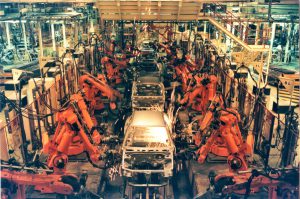
Image: Spencer Cooper,rover 200 framing line (CC BY-ND 2.0)

Comments
Welcome to mreligion comments! Please keep conversations courteous and on-topic. To fosterproductive and respectful conversations, you may see comments from our Community Managers.
Sign up to post
Sort by
Show More Comments
RELIGION & LIBERTY ONLINE
Explainer: What’s Going On in Crimea?
Note: This is an updateand addition to two previous posts, “Explainer: What’s Going on in Ukraine?” and “What Just Happened with Russia and Ukraine?.” So what just happened in Crimea? On Sunday, Crimeans voted overwhelmingly to break with Ukraine and join Russia. Today Russian President Vladimir Putin signed a treaty making Crimea part of Russia (it was a former satellite state of the Soviet Union). Putin says he does not plan to seize any other regions of Ukraine. Why would...
Catholics and Anglicans Join Forces Against Slavery
There are more slaves today than were seized from Africa in four centuries of the trans-Atlantic slave trade. In fact, there are more slaves in the world today than at any other point in human history, with anestimated 21 million in bondageacross the globe. In an effort to eradicate modern slavery and human trafficking across the world by 2020, Pope Francis and Archbishop of Canterbury Justin Welby have personally given their backing to the newly-formed Global Freedom Network. The Global...
To Obey Is Better Than Sacrifice: A Challenge to ‘Good Intentions’
When decrying instances of do-gooder activism gone wrong, it’s e rather routine for critics to respond by saying,“good intentions aren’t enough” —and to a great extent, rightly so. Yet, as I’ve argued before, in addition to critiquing the es of our actions, we should also pause and ask whether our “good intentions” are all that good to begin with. If we are responding to some blurry impulse to “do something,” and that certain something ends up harming the very people...
Colloquium: Philosophy and Theology in the 21st Century
I am looking forward to presenting a paper at an ing colloquium in Berekely on July 16-20: “What has Athens to do with Jerusalem: Dialogue between Philosophy and Theology in the 21st Century.” From the colloquium press release: The Province of the Most Holy Name of Jesus (Western U.S.A.) and its center of studies, the Dominican School of Philosophy and Theology, will host a colloquium to discuss the intersection of philosophy and theology, titled: “What has Athens to do with...
What Would God’s March Madness Look Like?
“What would God’s March Madness look like?” asks David Mitchell in this week’s Acton Commentary. petition focus churches and church members the same way a college tournament focuses people on basketball?” What counts as service to others? If you prayed about it and decided that it was service that’s good enough. The intent is that service to friends and family might not count because that is something you are supposedly already doing. You’re already coaching your kids and mowing your...
‘Pretty Woman’ And Porn: Enslavement As Entertainment
The 1990 movie “Pretty Woman” is still wildly popular; it relies on the Hollywood canard of the “hooker with a heart of gold.” In the movie, a prostitute is paid to spend the weekend with a wealthy handsome gentleman. The two fall in love, and she is swept off her feet by the courtly man who initially wished only to utilize her. Cue the hankies, sigh for the romance, and fade to black. Now, the movie is being made into...
Video: Lawrence Reed on the Best and Worst American Presidents
Last week, Acton ed Lawrence Reed to the podium of the Mark Murray Auditorium for his Acton Lecture Series address, entitled American Presidents: The Best and the Worst. Reed, the President of the Foundation for Economic Education, tackled the subject with his usual grace and an evident (and praiseworthy) passion for the protection of the individual liberties of average citizens from the ever-expanding power of central government. Reed’s address is now available in full on YouTube, and is posted below....
What Were the First Historical Documents to Examine Religious Freedom?
When was the concept of freedom of religion first mentioned by secular governments? Robert Louis Wilken, professor emeritus at the University of Virginia and the author ofThe First Thousand Years: A Global History of Christianity,provides the answer: (Via: Justin Taylor) ...
Crooked and Proud: Edwin Edwards Returns to Louisiana Politics
Edwin Edwards once declared that the only thing that could keep him from Louisiana’s governor’s mansion was getting caught in bed with a “dead girl or a live boy.” He’s been called “The Luca Brasi of the Bayou,” “The Silver Zipper,” and “The Pirate Kingfish.” When Edwards ran against and trounced former Ku Klux Klan leader David Duke in the 1988 governor’s race, he had bumper stickers printed up that read, “Vote for the Crook. It’s Important.” He then declared...
Dear Future Mom: Children with Down Syndrome Are a Gift to Us All
“I’m expecting a baby,” writes a future mother. “I’ve discovered he has Down syndrome. I’m scared: what kind of life will my child have?” In response, CoorDown, an Italian organization that supports those with the disability, created the following video, answering the mother through the voices of 15 children with Down syndrome: “Your child can be happy,” they conclude, “and you’ll be happy, too.” Or, as Katrina Trinko summarizes: “Don’t be scared. Be excited.” That goes for the rest of...
Related Classification
Copyright 2023-2026 - www.mreligion.com All Rights Reserved






