

Home
/
RELIGION & LIBERTY ONLINE
/
Dietrich Bonhoeffer on the economy of love
May 14, 2026 4:37 AM

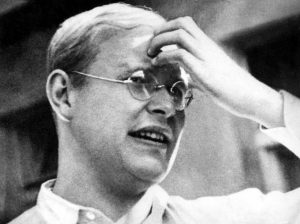
On August 12, 1943, months after having been arrested by the Gestapo and imprisoned, the Lutheran pastor and theologian Dietrich Bonhoeffer wrote to his young fiancée Maria von Wedemeyer:

When I consider the state of the world, the total obscurity enshrouding our personal destiny, and my present imprisonment, our union—if it wasn’t frivolity, which it certainly wasn’t—can only be a token of God’s grace and goodness, which summon us to believe in him. We would have to be blind not to see that. When Jeremiah said, in his people’s hour of direst need, that “houses and fields [and vineyards] shall again be bought in this land,” it was a token of confidence in the future. That requires faith, and may God grant it to us daily. I don’t mean the faith that flees the world, but the faith that endures in the world and loves and remains true to that world in spite of all the hardships it brings us. Our marriage must be a ‘yes’ to God’s earth. It must strengthen our resolve to do and plish something on earth. I fear that Christians who venture to stand on earth on only one leg will stand in heaven on only one leg too.

Here Bonhoeffer answers a question raised in For the Life of the World: Letters to the Exiles (FLOW), particularly in the episode on “The Economy of Love.” In this episode, we ask “What is saying ‘yes’ to another person really all about?” For Bonhoeffer, saying “yes” to another person is an affirmation of God’s world and his purposes therein.

Bonhoeffer invokes the example of Jeremiah, another inspiration for the theme of exile that permeates FLOW. In Jeremiah 32 we read about how, with the Babylonian exile looming, the prophet buys a plot of land and passes along this promise: “This is what the Lord Almighty, the God of Israel, says: Houses, fields and vineyards will again be bought in this land.” Marriage is a “yes” to God’s creation, even in the midst of exile, and a “yes” to God’s purposes for the life of the world.

Here’s a clip from the episode on “The Economy of Love.” It is my personal favorite in the series and mend it to you this Valentine’s Day weekend.

Comments
Welcome to mreligion comments! Please keep conversations courteous and on-topic. To fosterproductive and respectful conversations, you may see comments from our Community Managers.
Sign up to post
Sort by
Show More Comments
RELIGION & LIBERTY ONLINE
Samuel Gregg: Santorum, Tocqueville, and the Economy
On the National Catholic Register, Kathryn Jean Lopez takes a look at the strong finish by Rick Santorum in the Iowa Caucuses. She writes that the candidate’s dead heat finish with Mitt Romney marks “the emergence of a different kind of Catholic candidate in American politics, one who refuses to give up the fight on social justice — substantively and rhetorically — in practice and linguistics.” Lopez interviews Acton Research Director Samuel Gregg, who observes that “where Santorum adds something...
Samuel Gregg: The Problem with Compassionate Conservatism
On National Review Online, Acton Research Director Samuel Gregg reacts to musings by conservative writers David Brooks and Michael Gerson about Rick Santorum’s political rise in the GOP primaries and how his social views might be expressed in government policy. Would a President Santorum usher in a smaller but more “transformational” role for the state in addressing social ills? Gregg: On the one hand, passionate conservatives understand there is no such thing as morally neutral laws or morally indifferent government...
Ministries of Common and Special Grace
Should the President of the United States be seen as theologian-in-chief? That might be one way to understand Bryan Fischer’s claim that “we are in fact choosing a minister when we select a president.” I explore some of the dimensions of understanding politicians as “ministers of God” in this week’s Acton Commentary, “Ministers of Common Grace.” It strikes me that those who seek salvation from politicians are making a significant category mistake. Politicians cannot save because politics cannot save. Politics...
Review: Blue Collar Intellectuals
“Stupid is the new smart,” and “Pop culture is a wasteland” are just a few lines from Daniel J. Flynn’s introduction to Blue Collar Intellectuals: When the Enlightened and the Everyman Elevated America. Certainly, one does not need to read Flynn’s account to surmise that there are grave problems with our culture. But many would miss some great stories and a return to a people and time that crafted a great uplifting for mass audiences. Flynn has profiled six intellectuals...
I, iPhone
The latest episode of This American Life follows the story of Mike Daisey and his investigation into the origins of Apple products, especially the iPhone which is “Made in China.” What might the iPhone say if it could speak for itself? Ira Glass provides some answers to such a question in the opening moments of this episode, “Mr. Daisey and the Apple Factory.” It’s illuminating that Daisey half-jokingly describes his devotion to Apple products in religious terms (this doesn’t prevent...
Analysis: Catholic Charities of Tulsa Rejects Government Funding
Acton President Rev. Robert A. Sirico and Research Director Samuel Gregg were interviewed for a article about a decision by Catholic Charities of the Diocese of Tulsa to rely strictly on private donations for its work. Reporter Ben Johnson observed that the policy shift “stands in stark contrast to most of the benevolent institution’s other affiliates. Catholic Charities around the country received $1 billion from the government, approximately two-thirds of their funding.” Johnson: Some critics believe only foregoing government funds...
Ministry, Service, and Stewardship in Biblical Perspective
In this week’s Acton Commentary, “Ministers of Common Grace,” I note that in addition to ministry, “Another scriptural term, that of stewardship, can helpfully describe the pluriformity of God’s grace, both special mon: ‘Each of you should use whatever gift you have received to serve others, as faithful stewards of God’s grace in its various forms’ (1 Peter 4:10 NIV).” I conclude by calling for “better attention to the overlap and varieties of these biblical terms.” What I have primarily...
Faith and Food Trucks
In last week’s Acton Commentary, “Food Fights and Free Enterprise,” I take a look at the food truck phenomenon in US cities, sometimes called a “craze.” In panion blog post, “Food Trucks and First Steps,” I refer to Milton Friedman’s observation that there is a difference between being pro-market and pro-business. Art Carden has more on this over at Forbes. As I note in the piece, the fight over food trucks is not just the stuff of big cities. The...
Ecology, Theophany, and Economics
Last Friday, January 6, marked the Orthodox Christian feast of Theophany (Epiphany in the West). memorates the baptism of Jesus Christ by John in the Jordan river, the manifestation of the Trinity to those present, and the sanctification of the waters through their contact with God incarnate. Every year this last aspect of the feast stands as a reminder of the Christian viewpoint of God’s concern for the world he created. Indeed, according to a hymn from the Great Blessing...
Audio: Jordan Ballor on Christian Responses to Occupy Wall Street
Jordan Ballor is a busy man. He serves as a research fellow here at Acton, as well as being the executive editor of the Journal of Markets & Morality. As if those duties don’t keep him busy enough, he also finds time to do the occasional radio interview, in this case on 101.5 WORD FM in Pittsburgh, Pennsylvania, discussing how Christians should react to the Occupy Wall Street movement. For some additional perspectives on the issue, check out this Think...
Related Classification
Copyright 2023-2026 - www.mreligion.com All Rights Reserved





