

Home
/
RELIGION & LIBERTY ONLINE
/
Dietrich Bonhoeffer on the economy of love
Feb 11, 2026 8:50 AM

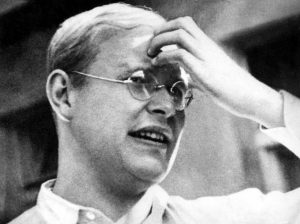
On August 12, 1943, months after having been arrested by the Gestapo and imprisoned, the Lutheran pastor and theologian Dietrich Bonhoeffer wrote to his young fiancée Maria von Wedemeyer:

When I consider the state of the world, the total obscurity enshrouding our personal destiny, and my present imprisonment, our union—if it wasn’t frivolity, which it certainly wasn’t—can only be a token of God’s grace and goodness, which summon us to believe in him. We would have to be blind not to see that. When Jeremiah said, in his people’s hour of direst need, that “houses and fields [and vineyards] shall again be bought in this land,” it was a token of confidence in the future. That requires faith, and may God grant it to us daily. I don’t mean the faith that flees the world, but the faith that endures in the world and loves and remains true to that world in spite of all the hardships it brings us. Our marriage must be a ‘yes’ to God’s earth. It must strengthen our resolve to do and plish something on earth. I fear that Christians who venture to stand on earth on only one leg will stand in heaven on only one leg too.

Here Bonhoeffer answers a question raised in For the Life of the World: Letters to the Exiles (FLOW), particularly in the episode on “The Economy of Love.” In this episode, we ask “What is saying ‘yes’ to another person really all about?” For Bonhoeffer, saying “yes” to another person is an affirmation of God’s world and his purposes therein.

Bonhoeffer invokes the example of Jeremiah, another inspiration for the theme of exile that permeates FLOW. In Jeremiah 32 we read about how, with the Babylonian exile looming, the prophet buys a plot of land and passes along this promise: “This is what the Lord Almighty, the God of Israel, says: Houses, fields and vineyards will again be bought in this land.” Marriage is a “yes” to God’s creation, even in the midst of exile, and a “yes” to God’s purposes for the life of the world.

Here’s a clip from the episode on “The Economy of Love.” It is my personal favorite in the series and mend it to you this Valentine’s Day weekend.


Comments
Welcome to mreligion comments! Please keep conversations courteous and on-topic. To fosterproductive and respectful conversations, you may see comments from our Community Managers.
Sign up to post
Sort by
Show More Comments
RELIGION & LIBERTY ONLINE
Corruption And Bribery: The Cost Of Health Care In Central And Eastern Europe
It is no secret that rule of law in places like Slovakia is weak. Corruption, pay-offs, bribes and twisted use of power often pass for “rule of law.” However, this problem has infected health care as well, which means those who are able to bribe the doctor or health care worker is the one who will get the care. The Economist describes Communist-era corruption as a holdover infesting much of central and eastern Europe, and not just in health care....
A Creative Aid For Dyslexia
Most of us take reading for granted. We learned how to do it when we were very young and we can do it with ease every day. However, for people with dyslexia (as much as 17 percent of the population) reading is a constant struggle. Dyslexia has nothing to do with intelligence, but it makes reading (and therefore learning) difficult. Aside from difficulty with pre-literacy learning like rhyming and letter recognition, the mon sign is when a child fails to...
Radio Free Acton: Gene Veith on Reformation and Vocation
A few weeks back, Acton ed Gene Edward Veith to the Mark Murray Auditorium as part of the 2015 Acton Lecture Series. This week, I had the opportunity to talk with Veith for this edition of Radio Free Acton. We discuss the influence of the Protestant Reformation on the development of capitalism, Luther’s beliefs on vocation, and how young people can discern their vocations as they contemplate their futures. You can listen to the podcast via the audio player below;...
The Greek Orthodox Bishop Who Stood Up to the Nazis
Archbishop DamaskinosThis is a doubly significant day in the nation of Greece in that not only is the Annunciation of the Theotokos (Virgin Mary) observed but also Independence Day. March memorates the start of the War of Greek Independence in 1821 against the Ottoman Empire and the tourkokratia or Turkish rule that is traced back to the fall of Constantinople in 1453. The occasion is marked with much pomp, parades and speech making in Greece and where large numbers of...
Explainer: What’s Going on in Yemen?
What just happened in Yemen? Yemen, the poorest country in the Middle East, has been in a state of political crisis since 2011 when a series of street protests began against poverty, unemployment, corruption. In recent months, though, Yemen has been driven even further into instability by conflicts between several different groups, pushing the country “to the edge of civil war,” according to the UN’s special adviser. Yesterday, to prevent further instability, a coalition led by Saudi Arabia launched air...
Lessons on Work and Civilization from ‘Katy and the Big Snow’
“No work? Then nothing else either. Culture and civilization don’t just happen. They are made to happen and to keep happening — by God the Holy Spirit, through our work.” –Lester DeKoster As we beginto discover God’s design and purpose for our work, there there’s a temptation to elevatecertain jobsor careers aboveothers, and attempt to inject our workwith meaning from the outside. Yet as long as we are serving our neighbors faithfully, productively, ethically, and inobedience to God’s will, the...
Rev. Sirico Interview in Buenos Aires: A Society with Lower Taxes is More Prosperous
While in Argentina for Acton Institute’s March 18 “Christianity and the Foundations of a Free Society” seminar, President and Co-Founder Rev. Robert A. Sirico conducted a wide ranging interview with La Nación, the country’s leading conservative newspaper. For more on the event, jointly sponsored with Instituto Acton Argentina, go here. What follows is an English translation of the interview. The original version, titled “Una sociedad con bajos impuestos es más próspera” in Spanish, may be found here. La Nación: Why...
A Hopeful Vision for Stewardship: Integrating Ecological Concerns and Economic Flourishing
Being a follower of Jesus includes a hopeful vision of the future. In the fullness of the kingdom of God, we will live on a new earth as embodied humans, worshiping and working, married to Christ and in fellowship with sisters and brothers from all nations (Rev. 21-22). There will be no more war, perfect justice, a restored ecology and each person will steward gifts and responsibilities consistent with his or her created design and fidelity during this present age...
Let’s Stop Expecting Islam to be Christian
One of the hot new trends in religious opinion today is to advocate for an “Islamic reformation.” This past weekend the Wall Street Journal ran two articles on the subject: “Islam’s Improbable Reformer” and “Why Islam Needs a Reformation.” Presumably, the assumption is that an Islamic Reformation would bring about the same beneficial changes as the Protestant Reformation. As mitted Protestant (Reformed, Evangelical, Southern Baptist) I believe the Reformation was indeed one of the most significant, and largely beneficial, events...
Archbishop Charles Chaput On Freedom And Faith
Archbishop Charles Chaput of Philadelphia recently gave a speech at a seminary. That – an archbishop addressing his seminarians – is in itself hardly noteworthy. However, Chaput had some profound and substantial things to say regarding freedom and faith. Our public discourse never gets down to what’s true and what isn’t, because it can’t. Our most important debates boil out to who can deploy the best words in the best way to get power. Words like “justice” have emotional throw...
Related Classification
Copyright 2023-2026 - www.mreligion.com All Rights Reserved




