Home
/
RELIGION & LIBERTY
/
Rediscovering the Sacred in Secular Spaces
Sep 11, 2026 2:46 AM

A French woman was raised a Roman Catholic but reveals that today she no longer considers herself one. Indeed, she has taken herself off the church rolls. When asked why, one might expect from her the sorts plaints usually leveled against established religion. But not in this case. Her answer came directly and without qualification: She could no longer afford to pay the taxes. It turns out that in France, to be a member of a church means to pay tribute to the state, which, in turn, supports various religious institutions. This lady simply decided to give herself a tax cut by ceasing to identify herself as a Catholic, in the same way someone might decide to save money by forgoing a night on the town.

Why doesn’t this woman think of her religious identity as a fundamental spiritual issue on which rests the fate of her soul? Why doesn’t she see that Christianity is not simply about being a part of a social group but, rather, about the most fundamental issue of our lives: the relationship between man and God?

It seems to me that what she has lost sight of–and this is true with Western culture in general–is the meaning and mystery of the sacred. This is a widespread problem in our day, when large institutions in society seem to deliver only secular messages. In response, religious leaders shift between two extremes: on the one hand, an aggressive triumphalism that seeks to battle the secular world through political action; on the other, a passive quietism that despairs of the world and counsels retreat into small sects of pietistic purity. In the spirit of Saint Thomas More, who said, “The times are never so bad that a good man cannot live in them,” I would like to suggest a third option. Seeds of the sacred are scattered throughout the secular cultural landscape, waiting to be discovered.

For example: One outstanding mark of our times is the dramatic economic change the world has undergone in the last ten years, change that has grown more conspicuous as the nightmare munism recedes into memory. Today, there is no longer any serious dispute that markets, prices, and private property–not government control–are the foundation of economic development.

Yet many Christians remain suspicious of the free market and, especially, of anything that smacks of mercialization” or modification.” They are not, however, making all the proper distinctions. It is one thing to remind of the traditional teaching that wealth is not an inherent good; it is quite another to say that wealth is capable of no good at all.

The material world cannot offer us salvation, to be sure, but it does not then follow that it is inherently corrupt. Christians make a grave error when they hold mercial culture has no redeeming value. This is why the Acton Institute continues to look for seeds of the sacred in the secular space mercial culture.

For example, through work, we learn service. Through entrepreneurship, we learn creativity. Through the personal responsibility required by the free economy–akin to the personal responsibility at the heart of our faith–we learn prudence and thrift. And through the expansion of international markets, we learn how to cooperate merce, in knowledge, and in the building of a peaceful and just world.

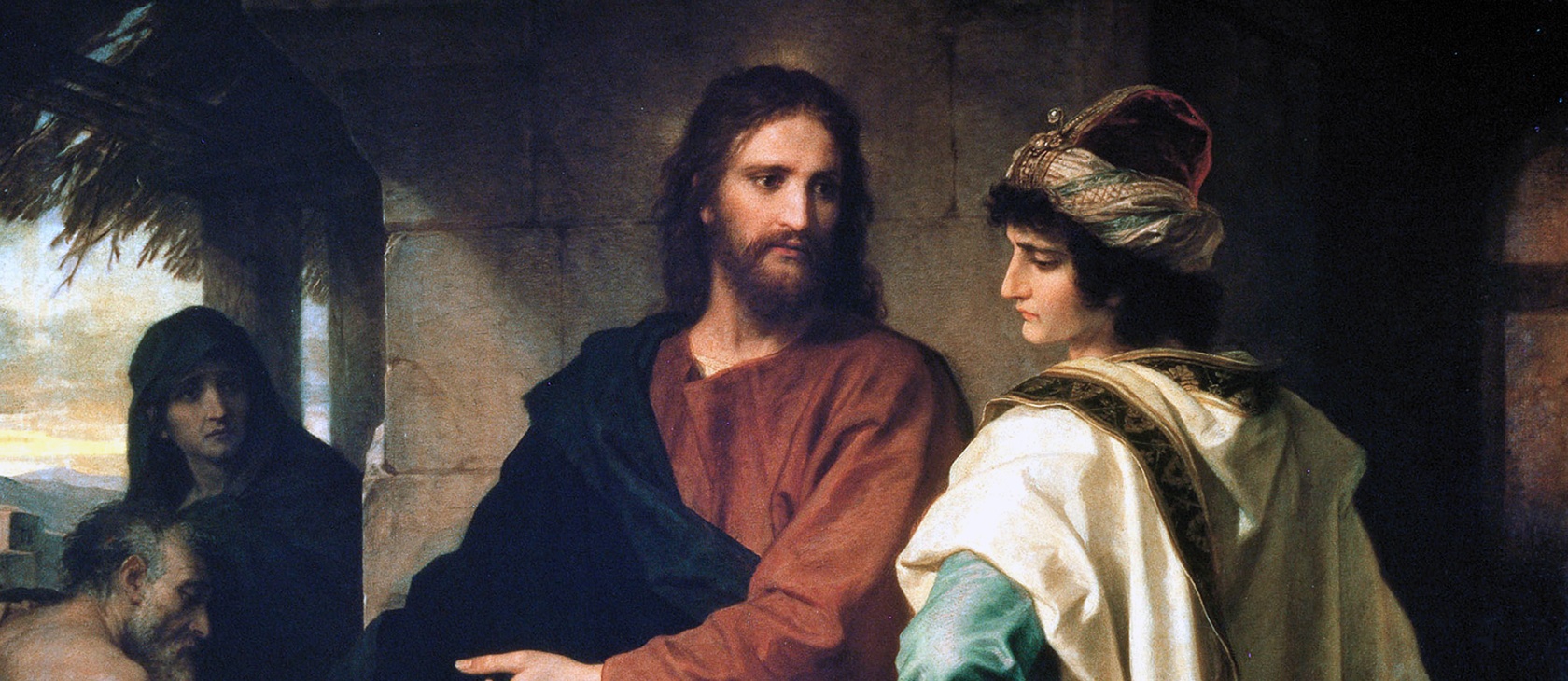
It is no accident that Jesus did not use simply wheat and grapes–the work of the earth untransformed–at the Last Supper. No, he used natural elements from earth transformed through human labor into bread and wine, which are then transformed again into our spiritual food and drink. Their use at the Lord’s Table teaches us that the work of our hands is not unfitting but, rather, especially fitting for sacred purposes. It teaches us how to discover beneath the seemingly inescapably mundane, secular world the transcendent beauty and power of God’s grace.

Comments
Welcome to mreligion comments! Please keep conversations courteous and on-topic. To fosterproductive and respectful conversations, you may see comments from our Community Managers.
Sign up to post
Sort by
Show More Comments
RELIGION & LIBERTY
Fighting Poverty with Virtue
Is America returning to a tradition of moral reform that had been rejected one hundred years ago? Consider the titles of the two major pieces of antipoverty legislation, each of which represents a generation's approach to this perennial social problem. The War on Poverty was ushered in by the Economic Opportunity Act of 1964, while the recent welfare reform legislation was the Personal Responsibility and Work Opportunity Reconciliation Act of 1996. The contrast between the laws, Joel Schwartz suggests,...
Christian Faith and Modern Democracy
mitted Roman Catholic, Robert Kraynak has produced one of the most significant political books for American Catholics since John Courtney Murray's We Hold These Truths. A professor of political theory at Colgate University, Kraynak deserves mention along with Murray, Jacques Maritain, and Reinhold Niebuhr as a mentator on the most profound of issues. His work will shake any reader, secular or faithful, to rethink the relationship between one's citizenship and one's faith. “We must face the disturbing dilemma that...
Citizen Kuyper: Born-Again American
There is not a square inch in the whole domain of our human existence over which Christ, who is Sovereign over all, does not cry, ‘Mine!'“ said Abraham Kuyper (1837—1920), a Dutch pastor-theologian by training and jack-of-many-trades by vocation. To say he practiced what he preached would be an understatement. From university founder and newspaper editor to party activist, statesman, and church reformer par excellence, Kuyper strove to live and teach in hopes of saving humanity–starting with his own...
More Money, More Ministry
Most of the sixteen essays in this volume originated at a consultation on “Evangelicals and Finance” in Naperville, Illinois, in early 1998. The purpose of the book is to take “a first step toward understanding how evangelicals have thought about, used, and raised money during the twentieth century.” The majority of its authors are historians and sociologists, so the perspectives are, for the most part, historical and social in nature. Perhaps the most obvious feature of the book is...
What Is Common about the Common Good?
John Calvin, reflecting on the truths found in “secular writers,” concluded that “the mind of man, though fallen and perverted from its wholeness, is nevertheless clothed and ornamented with God's excellent gifts” (Institutes, ii.2.15). Richard Mouw, in He Shines in All That's Fair (the text of his 2000 Stob Lectures), exhorts us to take hold of this insight, lest we miss in this world signs of mon grace. Mouw begins with the question, “What is it that Christians can...
Globalization and the Kingdom of God
Globalization and the Kingdom of God contains the annual Kuyper Lecture, presented at the Center for Public Justice in 1999, along with responses by mentators.The lecture was delivered by Bob Goudzwaard, Professor Emeritus, Free University of Amsterdam. Goudzwaard also served in the Dutch Parliament in the 1970s and is a well-respected authority on issues of Christian faith, economics, and public policy. The responses were given by Brian Fikkert, Covenant College; Larry Reed, Opportunity International; and Adolfo Garcia de la...
A Humanist for Our Time
The story of Wilhelm Röpke's life is that of a genuine Renaissance man—though in the tradition of Erasmus rather than Machiavelli. It is the tale of a man bined profound knowledge of several intellectual disciplines with a genuine confidence that people can indeed know the truth. But one of the strengths of John Zmirak's new intellectual biography is that it underlines the extent to which Röpke's life was also a tale of profound moral witness to truth. For his...
Environmental Virtues-and Vices
Religious writing on the environment generally fails for several specific reasons. First, most theologians and religious ethicists do not have a gift for science. Environmental science is especially hard because it requires, at a minimum, a good grasp of chemistry, physics, geology, and various subdivisions of biology. The scientist who can keep all the environmental balls in the air simultaneously is already a rare bird; but the theologian who can successfully apply his religious knowledge to a very different...
Why a Free Society Needs the Family
Children who spend their formative years deprived of the love and attention of caring families often have grave difficulties forming attachments throughout their lives. Locked away inside themselves, they care nothing about what others think of them—whether love, hate, or indifference. Only fear of physical force or loss of privileges can motivate them to good behavior. Otherwise, these damaged children do what they rationally calculate they can get away with—lying, cheating, stealing, and hurting others without conscience. As adults,...
Rising to the Challenge of Modern Capitalism (Or Not)
What is the relationship between Christianity and the modern world? Is the spirit of capitalism fundamentally patible with the requirements of charity that were first formulated in the New Testament? While these have always been important questions for Christians, they have taken on a renewed sense of urgency. The recent terrorist attacks on New York and Washington forcefully reminded Americans that they cannot escape the question of the relationship between God and politics. On that day, the most economically...
Related Classification
Copyright 2023-2026 - www.mreligion.com All Rights Reserved