


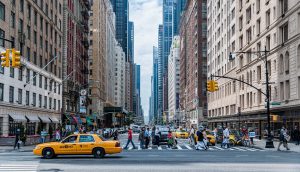
In the mid-20th-century, American cities suffered a wave of violent crime and poverty, due in part to shifts in the economy and public policy, as well as mass suburbanization. Yet in recent decades, those same cities are experiencing somewhat of a renewal.
Crime rates are falling. Prosperity is on the rise. And new opportunities for growth, diversity, and innovation abound.
“We are at the dawn of the urban century,” writes Michael Hendrix in a new report from AEI’s Values & Capitalism project. “More Americans are living in cities than ever before. These Americans are younger, smarter, and more global. Nearly 81 percent of Americans live in urban areas. The city is humanity, magnified.”
What’s good for the city is good for America, Hendrix argues1, pointing to Alexis de Tocqueville’s original vision of an America bound together by townships large and small, that together create a plex web of ties to people and institutions grounded in trust and respect.” For Tocqueville, those relationships were “the lifeblood of democracy and the spirit of enterprise.”
But despite all that promise, Hendrix sees a range of obstacles and policy pressures that continue to threaten our urban renaissance. “For too many people in too many places in this country, cities are closed economically and politically to their advancement,” he writes. “This is a tragedy individually and collectively for the American project.”
The report, titled “The Closing of the American City,” seeks to more clearly define the American city — its ideal role and contribution — and explore ways to further the same type of openness and opportunity that made our country great from the beginning. “This, after all, is the central question of urban policy,” Hendrix writes. “Since human flourishing is tied to human togetherness, how we express this relationship in the form munity and our built environment matters greatly to the human experience.”
In assessing the core problems, Hendrix points specifically to expensive housing costs, price controls, onerous regulation, and cronyist governance, the sum of which serves to diminish access to the pond and stunt diversity, creativity, and investment.
At the dawning of the city, we are doing everything we can to turn off the lights. Too many American cities do not offer the opportunities for success and growth that they should, especially for those climbing the socioeconomic ladder. In many cases, city governments are opaque and inept. This lack of opportunity and dysfunction happens because our cities are too often closed to ers by virtue of their economy and politics. Many of our most prosperous cities are inaccessible to all but the wealthiest and the single. Rather than asking why cities are growing, we should ask why they are not growing more.
Burdensome regulation makes it difficult, if not downright impossible, to build sufficient housing or get the permits necessary to start a business. A lack of transparency makes it difficult to know whether anyone is trying to fix the situation. These barriers matter not simply because the city matters but because people matter. And if people cannot afford to start a family, buy a home, or have a voice in the political process, then what good is the city?
Hendrix examines the details and dynamics of each individual area, assessing how we might adapt our policies to leverage human ingenuity rather than discourage it.
But while the practical solutions may vary, each ought to be tied to mitment to the same type of openness and freedom that Tocqueville once observed and admired.
What Tocqueville saw merce munity ing basic patterns of American life. Walking the streets of Boston, away from the stately halls of government and into the throngs of people going about their lives, gave him an eye into the virtues of our greatest towns and cities. He saw in them a freedom to improve one’s lot in life, the virtues of work and learning, and the elevation of private interest and voluntary association for mon good. America was reared on these ideals.
Cities today, as then, must break down the barriers standing in the way of free people associating with one another, trading with one another, and learning from one another. This work begins at the street level, harnessing America’s dynamism and diversity to elevate the best ideas from the bottom up, and succeeds through the work of the individuals and institutions working closest to munities. America’s future is the sum of its people living munity, unfettered and free.
In that sense, a new urban agenda requires a healthy critique of the present and a hearty remembrance of the old. It requires a mitment to cultivating authentic, munities built on free exchange among free peoples.
“We must free people and markets to advance the cause of the places in which we live,” Hendrix concludes. “In so doing, America’s cities will be beacons of hope and opportunity for the future.”
Image: Public Domain, CC0









 zpostcode
 Recruit
 weather
 mreligion
 Yellowpages
 sport
sport constellation
 shopping
 name
name game
game directory
 literature
 Word
Word tour
tour furnish
 Lottery
 tftnews
 lyrics
 News
News digital
 car
car dir
dir Edu
Edu Finance


